

7:00 am Registration Desk & Check-in (Full Breakfast) 8:30 am Welcome - with Jaspreet Sidhu, University of California Agriculture & Natural Resources 8:45 am Opening Remarks- with Leonel R. Jimenez, County Director Tulare, Kings & Kern, University of California Agriculture and Natural Resources 9:00 am Vegetables and Vitamins, Carrots and Carotenes - with Phillip Simon, USDA, ARS, Vegetable Crops Research Unit, Plant & Agroecosystem Sciences, University of Wisconsin, Madison. 9:30 am Session 1:Breeding and Genetics - Moderated by Laura Maupin
Recent advance toward a carrot chromosome scale pangenome, Massimo Iorizzo
Development of carrot texture phenotyping methodology and characterization of texture variation for genetic analysis and crop improvement, Avelina Gaston
Multi-year field evaluation reveals phenotypic diversity for Alternaria leaf blight susceptibility in wild and landrace carrot germplasm, Fernanda Rodrigues Silva
Three-Dimensional Chromatin Organization in Carrot: Identification and Characterization of Topologically Associating Domains, Monika Szewczyk
10:15 am Coffee Break, Networking and Poster Viewing
Genetic Mapping of Root Color and Top Morphology via QTL Analysis and Dissection of Flowering time Through Whole-Genome Resequencing-Based BSA in Carrot, Santosh Hadagali
Gene discovery and marker-assisted breeding for nematode resistance in carrots, Bao-Lam Huynh
Characterizing Root-Knot Nematode Resistance in a Diverse Collection of Carrot (Daucus carota L.) Germplasm, Kevser Ozel
Discovery of Major Effect Top Size QTL to Improve Weed Competitiveness in Carrot, Tony Schu
11:45 am Session 2:Pest Management - Moderated by Mary Ruth McDonald
Differences in susceptibility to cavity spot and Alternaria leaf blight in carrot lines and cultivars, Mary Ruth McDonald
Aerobiology and management of powdery mildew in carrot seed crops, Jeremiah Dung
12:15 pm Lunch 1:15 pm Session 2: Pest Management (continued...)
Current Ideas about Managing Plant Parasitic Nematodes in Conventional and Organic Carrot Production in Central and Southern California, Alan Butterfield
Are biological and conventional non-fumigant nematicides effective at managing root-knot nematodes in carrot production? Zane J. Grabau
Root-Knot Nematodes Control using Encapsulated Plant Extracts, Rewa Rai
Tying up the Knot- Developing commercial carrot hybrids to protect yields from Root knot nematodes, Peter Rogers
Fluorinated non-fumigant nematicides for managing the root-knot nematode Meloidogyne incognita in carrots, Antoon Ploeg
Biological fungicides for managing Alternaria leaf blight in organic carrots in California,Jaspreet Sidhu
Evaluation of conventional and organic products for control of foliar and root pathogens of carrot in Michigan, Ethan Tippett
Alternaria Leaf Blight Management in Florida Carrots: Pathogen Characterization, Fungicide Efficacy, and Regenerative Farming Strategies,Chun-Hsiang (Sean) Wang
3:15 pm Coffee Break, Networking and Poster Viewing 3:30 pm Session 2: Pest Management (continued...)
Comparison of robotic and conventional weed management in carrot fields in Ontario, Canada, Kevin Vander Kooi
Screening of Carrot Genotypes for Drought Tolerance Using Morphological and Physiological Approaches, Md. Harun Ar Rashid
4:00 pmIndustry Updates - Moderated by Aaron Hegde
IR4 Project, Kari Arnold
Certis Biologicals, Jeremy Wagnitz
Corteva Agriscience, Stacey Swanson
Bayer U.S- Seminis Vegetable Seeds, Laura Maupin
Lallemand Plant Care, Zephyr Papin-Tillery
Gowan, Anna D. Howell-O'Bosky
Nutrien Ag Solutions, Jeff Palmbach
ISK BioSciences, Marija Ward
Kulo Bio, David Chappell
5:30 pm Sessions Adjourn
6:00 pm Reception and Poster Session (Dinner)
Breakfast, Lunch & Dinner provided
Wednesday, June 3
6:30 am (Full Breakfast) 7:30 am - 12:00 pm Field Tours
(Field Tours depart at 7:30 am)
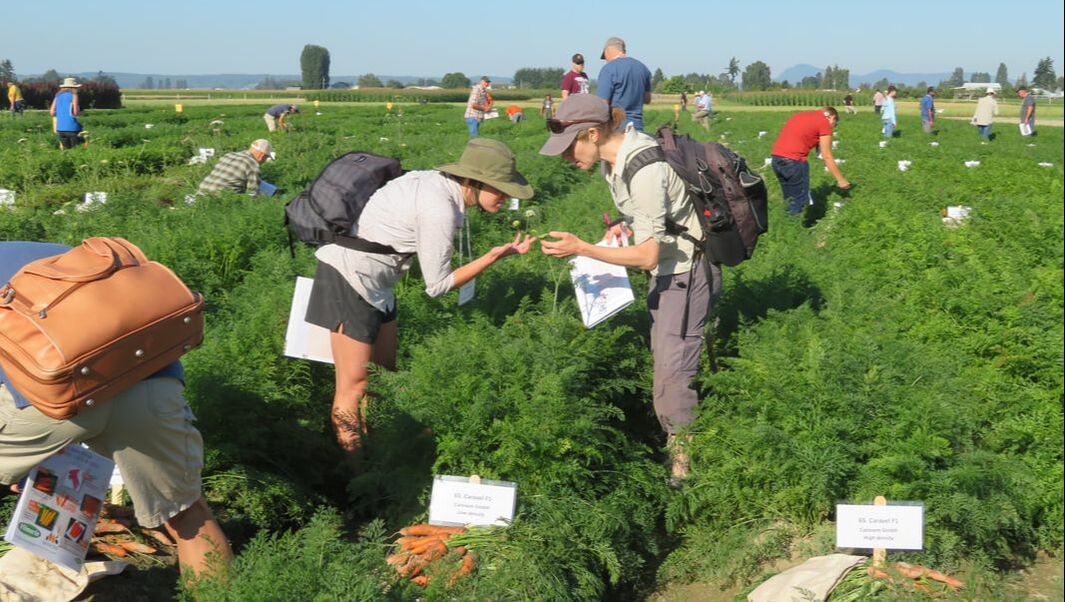
Conventional Variety Trial
Alternaria Variety Trial
Processing Plant Tour (Limited Availability)
12:15 pm Lunch back at the hotel 1:15 pm Session 3: Nutrition and Flavor - Moderated byIsolde Francscis
Carrot as a source of natural colorant: working toward a molecular strategy to increase anthocyanin accumulation in carrot root, Muhammad Ali Abid
First anthocyanin GWAS in carrot advances genetic discoveries and identifies targets for DNA markers, Romit Seth
CRISPR RNP-Mediated Functional Validation of Acid Soluble Invertase Isozyme II in Carrot Protoplasts, Gunay Yildiz
Yield and Quality of Carrot Cultivars in Sandy Soils in Florida with Eight Nitrogen Rates and Best Management Practices, Robert Hochmuth
Improving irrigation and nitrogen management in desert carrot production: insights from multi-year field experiments, Ali Montazar
Assessment of carrot response to different nitrogen application rates and irrigation amounts, Tobias Oker
2:55 PM Session 5: Economics - Moderated by Kevser Ozel
Economics of Carrot Supply and Supply Response to Price and Farm Costs to Help Guide the Payoff to Carrot R&D, Olena Sambucci
Economics of carrot demand and demand response to price, focusing on the potential of R&D to influence the market for US-grown carrots, Daniel Sumner
3:15 pmPlanning the 43rd International Carrot Conference 3:25 pm Closing Remarks 3:30 pmBridging the Gap: Industry-researcher Stakeholder Panel Discussion
To discuss challenges the carrot industry is facing and the inevitable future concerns and to guide and steer research towards commercial industry relevance